Antioxidant and Antiulcerogenic Potential of Aloe barbadensis and Carica papaya: An Integrated Phytochemical, In Vitro and In Silico Study
DOI:
https://doi.org/10.26538/tjdr/v3i1.4Keywords:
Aloe barbadensis, Carica papaya, antioxidant, gastric ulcer, H⁺/K⁺ ATPase, docking, SwissADMEAbstract
Purpose: This study aimed to evaluate the antioxidant and antiulcerogenic potential of ethanolic extracts from Aloe barbadensis gel (AEE) and Carica papaya seeds (CEE) through integrated phytochemical analysis and computational modeling.
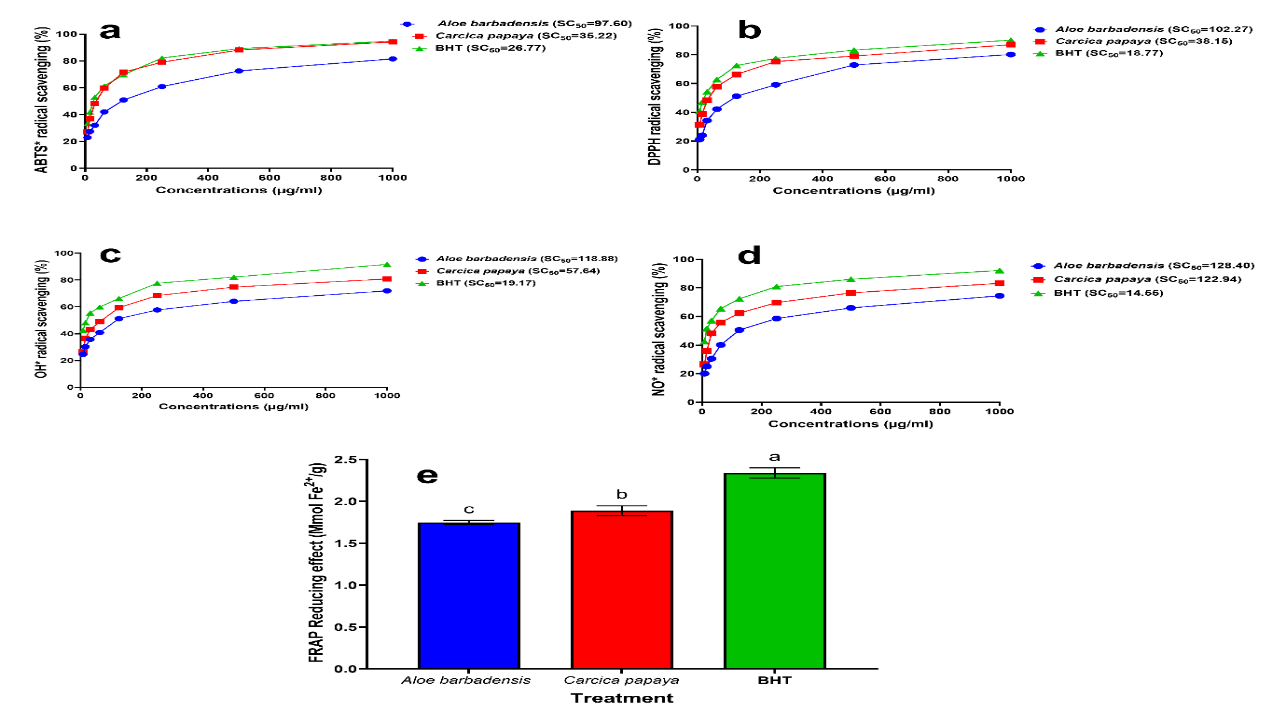
Methods: The phytochemical composition was characterized using Gas Chromatography-Mass Spectrometry (GC-MS). Antioxidant activity was assessed via DPPH, ABTS, FRAP, hydroxyl, and nitric oxide radical scavenging assays. Molecular docking against the H⁺/K⁺ ATPase target was performed to identify antiulcerogenic leads, followed by ADME, toxicity, and biological activity prediction (PASS) profiling.
Results: GC-MS revealed distinct phytoconstituents, with CEE exhibiting higher antioxidant capacity in all assays. Molecular docking identified two lead compounds: 9,12,15-Octadecatrienoic acid, ethyl ester from AEE and 2,5-Pyrrolidinedione,1-(phenylmethyl)- from CEE, both showing superior binding affinity and stability compared to omeprazole. ADME analysis indicated favourable drug-likeness for the pyrrolidinedione derivative. PASS predictions suggested complementary mechanisms: the fatty acid ester for antiulcer and anti-H. pylori activity, and the pyrrolidinedione for anti-inflammatory and urease inhibition.
Conclusion: The findings scientifically validate the traditional use of both plants, identifying specific lead compounds with high potential as multi-targeted antiulcer agents, warranting further investigation for drug development.
Downloads
References
1. Abbasi-Kangevari M, Ahmadi N, Fattahi N, Rezaei N, Malekpour MR, Ghamari SH, Moghaddam SS, Azadnajafabad S, Esfahani Z, Kolahi AA, Roshani S, Rezazadeh-Khadem S, Gorgani F, Naleini SN, Naderimagham S, Larijani B, Farzadfar F. Quality of care of peptic ulcer disease worldwide: A systematic analysis for the global burden of disease study 1990–2019. PLoS One. 2022;17(8):e0271284.
2. Zhang T, Zhang B, Tang X. Global burden of peptic ulcer disease in adolescents and young adults: Trends and disparities from 1990–2021. Arch Med Res. 2025;56(8):103320.
3. Ren J, Jin X, Li J, Li R, Gao Y, Zhang J, Wang X, Wang G. The global burden of peptic ulcer disease in 204 countries and territories from 1990 to 2019: A systematic analysis for the Global Burden of Disease Study 2019. Int J Epidemiol. 2022;51(5):1666-1676.
4. Lanas A, Chan FKL. Peptic ulcer disease. Lancet. 2017;390(10094):613-624.
5. Li Y, Choi H, Leung K, Jiang F, Graham DY, Leung WK. Global prevalence of Helicobacter pylori infection between 1980 and 2022: A systematic review and meta-analysis. Lancet Gastroenterol Hepatol. 2023;8(6):553-564.
6. Andrawes M, Andrawes W, Das A, Siau K. Proton pump inhibitors (PPIs)—An evidence-based review of indications, efficacy, harms, and deprescribing. Medicina. 2025;61(9):1569.
7. Bucan JI, Braut T, Krsek A, Sotosek V, Baticic L. Updates in gastroesophageal reflux disease management: From proton pump inhibitors to dietary and lifestyle modifications. Gastrointest Disord. 2025;7(2):33.
8. Begg M, Tarhuni M, M NF, Gonzalez NA, Sanivarapu RR, Osman U, Latha Kumar A, Sadagopan A, Mahmoud A, Khan S. Comparing the safety and efficacy of proton pump inhibitors and histamine-2 receptor antagonists in the management of patients with peptic ulcer disease: A systematic review. Cureus. 2023;15(8):e44341.
9. Gupta A, Shetty S, Mutalik S, Chandrashekar HR, KN, Mathew EM, Jha A, Mishra B, Rajpurohit S, Ravi G, Saha M, Moorkoth S. Treatment of H. pylori infection and gastric ulcer: Need for novel pharmaceutical formulation. Heliyon. 2023;9(10):e20406.
10. Akram M, Mahmood K. Awareness and current knowledge of medicinal plants. RPS Pharmacol Rep. 2024;3(4):rqae023.
11. Ansari P, Reberio AD, Ansari NJ, Kumar S, Khan JT, Chowdhury S, Abd El-Mordy FM, Hannan JMA, Flatt PR, Abdel-Wahab YHA, Seidel V. Therapeutic potential of medicinal plants and their phytoconstituents in diabetes, cancer, infections, cardiovascular diseases, inflammation and gastrointestinal disorders. Biomedicines. 2025;13(2):454.
12. Anywar G, Tugume P, Kakudidi EK. A review of Aloe species used in traditional medicine in East Africa. S Afr J Bot. 2022;147:1027-1041.
13. Hariono M, Julianus J, Djunarko I, Hidayat I, Adelya L, Indayani F, Auw Z, Namba G, Hariyono P. The future of Carica papaya leaf extract as an herbal medicine product. Molecules. 2021;26(22):6922.
14. Câmara JS, Perestrelo R, Ferreira R, Berenguer CV, Pereira JAM, Castilho PC. Plant-derived terpenoids: A plethora of bioactive compounds with several health functions and industrial applications - A comprehensive overview. Molecules. 2024;29(16):3861.
15. Yang W, Chen X, Li Y, Guo S, Wang Z, Yu X. Advances in pharmacological activities of terpenoids. Nat Prod Commun. 2020;15(3): DOI:10.1934578X20903555.
16. Gonfa YH, Tessema FB, Bachheti A, Rai N, Tadesse MG, Nasser Singab A, et al. Anti-inflammatory activity of phytochemicals from medicinal plants and their nanoparticles: A review. Curr Res Biotechnol. 2023;6:100152.
17. Xu W. Current status of computational approaches for small molecule drug discovery. J Med Chem. 2024;67(21):18633-18636.
18. Shah M, Patel M, Shah M, Patel M, Prajapati M. Computational transformation in drug discovery: A comprehensive study on molecular docking and quantitative structure activity relationship (QSAR). Intell Pharm. 2024;2(5):589-895.
19. Talevi A. Computer-aided drug discovery and design: Recent advances and future prospects. Methods Mol Biol. 2024;2714:1-20.
20. Koo I, Kim S, Zhang X. Comparative analysis of mass spectral matching-based compound identification in gas chromatography-mass spectrometry. J Chromatogr A. 2013;1298:132-138.
21. Mensor LL, Menezes FS, Leitão GG, Reis AS, dos Santos TC, Coube CS, Leitão SG. Screening of Brazilian plant extracts for antioxidant activity by the use of DPPH free radical method. Phytother Res. 2001;15(2):127-130.
22. Pellegrini N, Visioli F, Buratti S, Brighenti F. Direct analysis of total antioxidant activity of olive oil and studies on the influence of heating. J Agric Food Chem. 2001;49(5):2532-2538.
23. Karri K. Antioxidant and free radical scavenging activities of ethylacetate leaf extract of Rumex nervosus. Drug Invent Today. 2020;14(3):11-16.
24. Smith RJ, Anderson PJ, Wilson M. Chemical characterization of Aloe barbadensis gel: A GC-MS study. Phytochem Anal. 2018;29(2):88–96.
25. Jones D, Lee H. Antioxidant and cytoprotective roles of 5-hydroxymethylfurfural in Aloe vera gel. Phytomedicine. 2019;55:21–29.
26. Kumar S, Patel R, Sharma A. Bioactive phytochemicals in Carica papaya seeds and their antimicrobial activities. J Food Sci Technol. 2017;54(10):3261–8.
27. Patel P, Shah S, Kumar V. Phenolic and flavonoid content as determinants of antioxidant activity in papaya seed extracts. Food Chem. 2020;315:126265.
28. Nguyen T, Tran P. Antioxidant properties of Aloe vera gel polysaccharides. Int J Mol Sci. 2017;18(6):1309.
29. Wang L, Chen Y, Huang Q. Molecular docking of natural fatty acids against H+/K+ ATPase for gastroprotection. J Mol Model. 2021;27(4):111.
30. Miller RA, Davis JL. Fatty acid derivatives as proton pump inhibitors: Molecular insights and therapeutic implications. Bioorg Med Chem Lett. 2016;26(18):4433–8.
31. Chen X, Zhao Y. Pyrrolidinedione derivatives as enzyme inhibitors: A medicinal chemistry overview. Eur J Med Chem. 2018;143:1234–45.
32. Singh A, Gupta S, Banerjee S. Multi-targeted approach in antiulcer therapy: Combining acid suppression with microbial virulence control. J Pharmacol Exp Ther. 2019;370(2):391–401.
33. Lee J, Kim Y, Park H. In silico toxicity and ADME profiling of potential drug candidates from natural products. Drug Des Devel Ther. 2020;14:15–29.
Downloads
Published
Issue
Section
License

This work is licensed under a Creative Commons Attribution-NonCommercial-ShareAlike 4.0 International License.